
We Are Never the Same Person Twice: Rethinking Judgments in a Fast-Changing World
01/17/2025
Have you ever met someone you thought you couldn’t stand, only to meet them again later and discover you actually enjoy their company? Or reconnected with an old friend, only to find they seem like an entirely new person? My wife recently mentioned this phenomenon after running into someone she had once disliked, only to realize she now genuinely liked them. It struck me because I had just experienced something similar with a close friend. Years ago, they were one kind of person, and today, they’re completely different. Or maybe it’s me who’s changed. Or maybe both of us have.

This got me thinking: we are not static beings. The person we present at any given moment is shaped by a complex cocktail of experiences, personality traits, needs, and aspirations that are influenced by both our long-term environment and fleeting, short-term factors like mood, stress, or external pressures. Essentially, who we are is a snapshot, not a sculpture. And like any snapshot, it captures a moment, not the whole story.
The Danger of One-Time Judgments
The main implication of this realization is profound: we should stop making long-term judgments about people based on one interaction. Sure, first impressions are powerful, but they’re also limited — and often unfair. Someone might seem arrogant when they’re really just nervous. A friend might come across as distant because they’re going through something you can’t see. As humans, we’re wired to judge quickly, but in today’s fast-paced, ever-evolving world, this instinct is more outdated than ever.
Think about it: in a world where technology, culture, and personal circumstances are changing at breakneck speed, people are changing too. The experiences we have, the challenges we face, and the opportunities we encounter can all reshape us faster than we might realize. The person you met last year, or even last month, might not be the same person you meet today. And that’s a good thing — it means we’re all capable of growth and transformation.
A Call for Curiosity
So, how do we respond to this? Instead of rushing to conclusions, let’s approach every interaction with curiosity. Treat each meeting, whether it’s with a stranger or a long-time acquaintance, as an opportunity to learn who they are right now. Suspend judgment and revisit your perceptions with every encounter. Who knows? The person you disliked last time might just surprise you. Or the person you admired might have some flaws worth understanding more deeply.
We’re all evolving, and that’s something to celebrate. So the next time you meet someone, whether for the first or the fiftieth time, ask yourself: who are they today? And maybe even more importantly, who are you today? Chances are, you’re not the same person you were either.
Let’s give each other the grace to grow — and the space to be seen anew.
The Liability of Kindness
06/28/2024
I am part of a generation where manners were as crucial as the message itself. Growing up, we were taught to say “please” and “thank you,” to address people respectfully, and to consider the impact of our words. These practices were not mere formalities but fundamental aspects of communication that conveyed respect and empathy. Even when I ask ChatGPT for assistance, I instinctively include polite phrases, as it feels unnatural to do otherwise. Today, I find it challenging to communicate without these ingrained habits.

Intoday’s fast-paced business environment, communication is transforming before our eyes. The rise of short messaging services and social media has revolutionized how we interact, often reducing our conversations to brief, functional exchanges. While this efficiency has its benefits, it often comes at the cost of kindness and empathy. The words we use have grown shorter, our expressions more clipped, and our interactions increasingly devoid of the warmth and consideration that once marked professional communication. This shift has brought with it a peculiar phenomenon: the liability of kindness.
In the corporate world, kindness can sometimes be misinterpreted as a sign of weakness. Those who continue to be kind and empathetic may find themselves taken advantage of or even treated rudely. For instance, consider a manager who always responds to emails with a friendly greeting and a courteous closing. Over time, this manager might be perceived as overly accommodating, leading others to pile tasks onto them or dismiss their polite requests. This situation is not uncommon; the expectation for immediate, no-nonsense communication often overshadows the value of maintaining a respectful tone.
Moreover, the anonymity and impersonality of digital communication can exacerbate this issue. Behind the safety of a screen, individuals may feel emboldened to act in ways they wouldn’t face-to-face. A professional who consistently responds with kindness might find themselves the target of rude or demanding messages. In such scenarios, the empathetic individual faces a dilemma: maintain their courteous demeanor and risk further mistreatment, or adopt a more curt and defensive stance to protect themselves.
Despite the challenges, kindness should not be viewed as a liability. Instead, it can be a powerful tool for fostering genuine connections and promoting positive interactions. Kindness can defuse tension, build trust, and encourage reciprocity. For example, a customer service representative who handles a complaint with patience and empathy is likely to leave a lasting positive impression on the customer, even if the issue was not resolved perfectly.
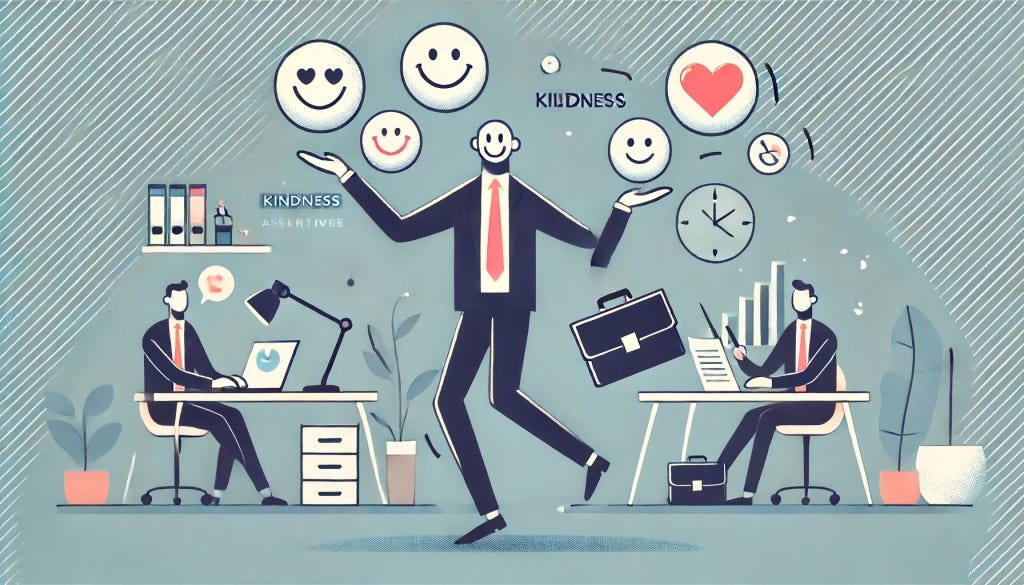
For managers, entrepreneurs, and corporate professionals, the key is to balance kindness with assertiveness. It’s important to set boundaries and communicate them clearly. Being kind doesn’t mean allowing others to take advantage of you. It means treating others with respect while also respecting yourself. Here are some practical strategies:
- Set Clear Expectations: When delegating tasks or setting deadlines, be clear about your expectations. Use kind language but be firm about what is required.
- Establish Boundaries: Politely but firmly communicate your boundaries. For instance, if you receive emails outside of working hours, respond during business hours with a note about your availability.
- Practice Active Listening: Show empathy by actively listening to colleagues and clients. Acknowledge their concerns and respond thoughtfully, balancing understanding with practical solutions.
- Provide Constructive Feedback: When offering feedback, combine kindness with clarity. Highlight positive aspects before addressing areas for improvement, ensuring your message is both respectful and effective.
- Model Respectful Communication: Lead by example. Demonstrate how to communicate respectfully and encourage your team to do the same. This can create a culture of kindness and mutual respect within your organization.
While the modern landscape of communication presents challenges for maintaining kindness, it is by no means impossible or undesirable. Kindness is not a weakness; it is a strength that, when balanced with assertiveness, can enhance our interactions and relationships. As we navigate this evolving digital world, let’s strive to keep kindness and empathy at the forefront of our communication, recognizing their enduring value even in the shortest of messages.
Not so fast, cowboy…
02/10/2024
In an era characterized by rapid technological advancements and instant gratification, the essence of due process seems to have taken a backseat in both education and career development. The traditional path of respecting oneself and the process, engaging in an apprenticeship to acquire a profession, has been overshadowed by a relentless pursuit of immediate outcomes. This shift towards a unidimensional outcome-focused approach is concerning, as it neglects the holistic development of individuals and undermines the fundamental principles of personal growth and societal progress.

Historically, the journey towards mastering a profession involved a deliberate and structured process of apprenticeship, where individuals not only acquired technical skills but also values such as discipline, perseverance, and respect for the craft. The emphasis was not solely on the end result but also on the journey itself, which fostered a deep understanding and appreciation for the intricacies of the chosen field.
However, contemporary society has witnessed a proliferation of expedited learning programs, commonly known as bootcamps, promising to equip individuals with the necessary skills to excel in specific jobs within a short timeframe, often as brief as six months. While these programs may seem appealing due to their efficiency and immediate results, they often fall short in nurturing well-rounded individuals.
The allure of quick-fix solutions overlooks the importance of holistic education, which extends beyond mere technical proficiency. A college degree or apprenticeship not only imparts basic knowledge and skills but also cultivates essential life skills such as collaboration, problem-solving, and effective communication. Moreover, it instills a philosophy of scientific inquiry, encouraging individuals to think critically, question assumptions, and seek innovative solutions — a mindset that transcends the confines of one’s immediate career and enriches all aspects of life.
By bypassing the traditional pathways of education and professional development, individuals risk being ill-equipped to navigate the complexities of the modern world. While they may possess the technical know-how to perform specific tasks, they may lack the adaptability, resilience, and emotional intelligence necessary to thrive in diverse environments and circumstances.
Furthermore, the erosion of due process in education and career development perpetuates a culture of instant gratification, where success is measured solely by tangible outcomes rather than personal growth and fulfillment. This narrow focus on short-term gains undermines the intrinsic value of the learning process and diminishes the importance of lifelong learning and continuous improvement.
To address these challenges, there is a need to reevaluate our priorities and reaffirm the value of due process in education and career development. This entails recognizing that true mastery and success are not achieved overnight but require dedication, perseverance, and a willingness to embrace challenges and setbacks along the way.
Educational institutions, employers, and policymakers play a pivotal role in promoting a balanced approach to learning and professional growth — one that values both technical proficiency and holistic development. This may involve reimagining curriculum design to incorporate experiential learning opportunities, mentorship programs, and interdisciplinary approaches that foster creativity, critical thinking, and ethical decision-making.
Moreover, individuals themselves must recognize the importance of investing in their personal and professional development over the long term, beyond the allure of quick-fix solutions. Embracing a mindset of lifelong learning and committing to ongoing self-improvement will not only enhance individual prospects but also contribute to the collective advancement of society.
The resurgence of due process in education and career development is essential to nurturing well-rounded individuals equipped to thrive in an increasingly complex and interconnected world. By valuing the journey as much as the destination, we can cultivate a generation of lifelong learners and resilient problem-solvers capable of confronting the challenges of tomorrow with confidence and integrity.
Embracing the Chaos: Navigating Parenthood and Innovation with Unpredictable Twists
11/30/2023

In the everyday dance of life, our best intentions don’t always lead to the smoothest outcomes. Whether it’s trying to calm a toddler tantrum or revolutionize an industry with a groundbreaking idea, the journey from good intentions to favorable results is often a zigzagging path.
Let’s start with parenting. Picture this: you, the well-meaning parent, trying to create a haven for your little one. You carefully pick educational toys, set boundaries, and do your best to shield them from failure. But here’s the twist – sometimes, that shield unintentionally hampers their ability to bounce back from setbacks. Suddenly, your attempt to nurture resilience ends up triggering unexpected tantrums when life throws a curveball.
Now, let’s zoom out to the world of business and innovation. Consider the smartphone revolution. The ingenious idea behind these pocket-sized devices was to make our lives more connected. But who could have predicted the unintended consequences? Our screen time skyrocketed, face-to-face interactions dwindled, and a whole new set of challenges emerged, all while we were busy trying to connect more than ever.
And here’s the thing about humans – we’re wonderfully complicated creatures. Multiply that complexity when we gather in families, communities, and societies. Each person brings their unique experiences and quirks to the table, creating a beautiful but intricate tapestry. Now toss in a game-changing innovation, and you’ve got a recipe for unforeseen consequences.
Take social media, for instance. Its creators envisioned a global community where people could share ideas and connect. But lo and behold, along came cyberbullying, fake news, and privacy nightmares. What was meant to unite ended up dividing, showcasing the unexpected twists that innovations can take in the real world.
But hey, this isn’t a call to halt progress. It’s more like a friendly reminder that the road to positive change is filled with bumps. So, how do we navigate this twisty path successfully?
Let’s borrow a page from the business playbook – the lean startup philosophy. Imagine you’re launching a new product. Instead of crossing your fingers and hoping for the best, you actively seek feedback. It’s like taking your prototype into the real world, observing how people use it, and tweaking it based on their experiences. This constant back-and-forth, this feedback loop, is your secret weapon against unexpected hiccups.So, whether you’re parenting or pioneering the next big thing, embrace the messiness. Expect the unexpected, build in safety nets, and be ready to pivot when things don’t go as planned. After all, life – like innovation – is an evolving journey, full of surprises, challenges, and the occasional tantrums. But in that chaos, there’s a chance for something remarkable to emerge – something that stands the test of time and adds a positive note to the grand symphony of human experience.
To AI or Not to AI: A Practical Perspective on Artificial Intelligence
09/18/2023

It’s hard to have a conversation about modern technology without mentioning Artificial Intelligence (AI). Just as William Shakespeare once pondered, “To be or not to be?”, we now find ourselves asking, “To AI or not to AI?” This question weighs heavily on our minds, especially when considering the rapid changes AI brings.
As a professor of entrepreneurship and a member of academia, my initial encounter with AI was tinged with apprehension. There was this looming question: Could AI alter higher education to the point of making it unrecognizable? Might it change academic research so drastically as to challenge the foundations of my career? But, like with most tools, the impact of AI isn’t just about the technology itself, but how we choose to use it.
Teaching with AI:
AI’s role in education is pretty exciting. Instead of a standard curriculum for all students, imagine if each student had lessons tailored just for them, adjusted in real-time based on how they learn best. That’s what AI offers—a dynamic shift from traditional to personalized learning.
Research Augmented by AI:
When I think about research, AI presents both challenges and opportunities. Yes, it can process vast amounts of data quickly. But its potential in qualitative research is what truly intrigues me. Consider this: using AI, we could “interview” key figures who have long since passed away, diving into their perspectives on critical topics. This capability could revolutionize areas of study that rely heavily on firsthand accounts and narratives.
Consulting in the Age of AI:
In the consulting world, data drives decisions. Here, AI offers a more accurate way to predict market trends or foresee potential business disruptions. With AI’s data-handling abilities, consultants can provide even better guidance to their clients. Combined with future thinking, I see immense potential of AI for businesses large and small; mature or nascent.
Transforming Work with AI:
From daily tasks to big projects, AI has a role to play in how we work. It can handle repetitive tasks, sort through complex data, and even help in decision-making processes. It’s not about replacing humans; it’s about enhancing what we can do.
Ethan Mollick’s work sheds light on this balanced approach. He sees AI as an addition to, not a replacement for, human skills. While AI can handle massive data or simulate interviews with historical figures, humans bring creativity, understanding, and empathy to the table. By combining these strengths, we can achieve so much more. I strongly recommend checking out his substack and weekly newsletter on the topic.
Our relationship with AI is a journey. There are challenges, sure, but also massive potential. If we approach AI with an open mind and a clear purpose, “To AI or not to AI” might just be the question that leads us to a brighter future.
There is no competition in Yoga: Lessons for Cooperation in a Complex World
08/31/2023

Yoga, an ancient practice that has transcended time and cultures, is often associated with physical postures and meditation. Yet, its essence goes beyond the realm of bodily flexibility; it offers valuable insights into human behavior, mindset, and even business strategies. The adage “there is no competition in Yoga” holds a profound meaning that extends far beyond the mat, offering a perspective that is relevant in today’s intricate global landscape. This idea, rooted in the individualized nature of Yoga practice, can be translated into a broader lesson of cooperation over competition, especially in the world of business.
The journey to understanding the absence of competition in Yoga often begins in a studio, where a seasoned instructor guides practitioners through poses, reminding them that Yoga is a personal journey. This sentiment was aptly captured when an instructor proclaimed that Yoga is not a competition, but rather a practice tailored to each individual. This proclamation prompts contemplation, inviting us to ponder the implications of competition, not only in Yoga but also in various other facets of life.
Modern society tends to foster a culture of comparison and competition. People frequently find themselves fixated on the achievements and progress of others, creating an environment where self-worth is measured against external metrics. However, the essence of Yoga contradicts this inclination, emphasizing that each person’s practice is unique and should be nurtured without comparison. Similarly, in the realm of business, a parallel can be drawn where the traditional approach centered on competition is giving way to a more cooperative mindset.
In the business world, competition has historically been the driving force behind strategy formulation. Organizations strove to secure a competitive advantage and defend it at all costs, often viewing the marketplace as a battlefield where only the strongest survive. This mentality led to a zero-sum perspective, where one company’s gain was inherently seen as another’s loss. However, this perspective is undergoing a transformation as businesses come to realize the potential of cooperation in creating shared value.
Cooperation in business is akin to the notion of growing the pie, rather than merely striving to secure a larger slice. This shift aligns with the Yoga philosophy of focusing on personal growth and self-improvement rather than comparison. Just as Yoga practitioners are encouraged to transcend the limits of their bodies and minds, businesses are now embracing a more expansive view of collaboration. Coopetition, a concept where competing companies also cooperate for mutual benefit, is a prime example of this evolving mindset. This strategy enables companies to harness collective strengths, tap into complementary resources, and ultimately create a larger, more abundant “pie” of opportunities.
The analogy of Yoga’s non-competitive approach and the evolving business landscape draws attention to the interconnectedness of actions and outcomes. In a world that is increasingly complex, interconnected, and interdependent, cooperation is emerging as a vital strategy for success. The challenges facing individuals and organizations are often intricate, requiring multifaceted solutions that transcend traditional boundaries. In such an environment, the lessons from Yoga remind us that cooperation fosters an environment of synergy, where the collaborative efforts of all parties can lead to solutions that are greater than the sum of their parts.So, the declaration that “there is no competition in Yoga” resonates deeply beyond the confines of a yoga studio. It serves as a reminder that personal growth and self-improvement are paramount, and the journey is unique for each individual. By extension, this principle applies to the business world, where cooperation is proving to be a superior strategy compared to relentless competition. Just as Yoga practitioners embrace their own path, businesses are finding value in nurturing collaborations that expand the boundaries of traditional competition. In today’s intricate and embedded global environment, cooperation is not just an idealistic notion; it’s a pragmatic approach that allows all parties to win, enabling the creation of value that transcends the confines of traditional competition.
Empathy in Organizations
08/24/2023

Organizations need to display balanced empathy towards all key stakeholders by focusing on multiple organizational outcomes. This means that, in order to be successful, organizations must consider the needs and interests of all of the groups that are impacted by their decisions, including employees, customers, shareholders, and the broader community.
Focusing on multiple organizational outcomes means that organizations must strive to achieve a balance between financial performance, social responsibility, and environmental sustainability. For example, an organization that is solely focused on maximizing profits may be successful in the short term, but this approach may come at the expense of its employees, customers, or the environment. On the other hand, an organization that is solely focused on social responsibility or environmental sustainability may struggle to remain financially viable in the long term.
In order to display balanced empathy towards all key stakeholders, organizations must consider the multiple outcomes that are important to different groups. For example, employees may be concerned about job security, fair compensation, and opportunities for professional development, while customers may be interested in the quality of products or services, convenience, and value for money. Shareholders may be focused on financial returns, while the broader community may be interested in the organization’s impact on the environment, social equity, and public health.
By considering the needs and interests of all key stakeholders and focusing on multiple organizational outcomes, organizations can build strong and sustainable relationships with the groups that they depend on for their success. This approach can lead to better decision-making, more satisfied stakeholders, and greater long-term success for the organization.
Empathy is a useful framework across all modern frameworks, including lean startup, design thinking, and agile method. This is because empathy, the ability to understand and share the feelings of others, is essential for successful innovation and problem-solving.
In the lean startup framework, empathy is essential for understanding the needs and pain points of customers, and for developing solutions that address their problems. By putting themselves in the shoes of their customers, entrepreneurs can identify opportunities for innovation and create products and services that are truly valuable and useful.
In design thinking, empathy is also a key component. Design thinkers use empathy to understand the needs and experiences of users, and to design solutions that are human-centered and intuitive. By empathizing with the people who will use their products or services, designers can create solutions that are both functional and emotionally satisfying.
Agile method also relies on empathy, as it involves close collaboration and communication between team members. In order to work together effectively, team members must be able to understand and support each other, and to adapt to changing circumstances. Empathy is essential for building strong and productive teams, and for ensuring that team members are able to work together effectively to deliver results.
Overall, empathy is a valuable framework across all modern frameworks, as it enables individuals and organizations to understand and respond to the needs and experiences of others. By using empathy, organizations can develop innovative solutions that are truly valuable and effective.
I am currently working on multiple research projects to explore these ideas further. In one of the projects, I am exploring the role of empathy in startup organizations especially in the healthcare industry. In another research project, I am exploring the role of empathy across levels in a single midsize organization between employees, between teams, with customers, as well as with other organizations & stakeholders. I hope to illustrate that multi-level empathy in organizations is not only good for all stakeholders but also is practical and pragmatically makes sense as it leads to multi-dimensional and long-term performance. Stay tuned for my findings…
Process Focus
08/12/2023

We need to be process oriented as opposed to being outcome oriented. While short-term solutions may seem more attractive because of their immediate impact, they are often not sustainable in the long term. Complex problems require long-term and complex solutions, and these can only be developed through a process-oriented approach.
Focusing on outcomes alone can lead to a tendency to look for quick fixes and easy solutions. This can result in decisions that are not well thought out or that do not take into account the needs and interests of all key stakeholders. In contrast, a process-oriented approach emphasizes careful planning, collaboration, and consideration of all relevant factors.
Adhering to due process is essential for developing effective and sustainable solutions to complex problems. This involves involving all key stakeholders in the decision-making process and allowing them to contribute their perspectives and expertise. By involving all stakeholders, organizations can develop solutions that are more likely to be accepted and supported by the people who are affected by them.
Slow, gradual, but consistent progress is also important in addressing complex problems. Quick fixes may provide temporary relief, but they are often not sufficient to address the root causes of the problem. By taking a long-term and incremental approach, organizations can make lasting improvements and create lasting value.Overall, we need to focus on being process oriented rather than outcome oriented. This approach allows us to develop complex and sustainable solutions to complex problems, and to involve all key stakeholders in the decision-making process. By adhering to due process and focusing on slow, gradual, but consistent progress, we can create lasting value and positive impact.
For personal guidance to process orientation I find the following books really helpful:
For organizational guidance to process orientation I find the following resources helpful:
The Hard Thing about Hard Things by Ben Horowitz
Future thinking: A critical organizational & personal skill for fast-changing times
08/01/2023
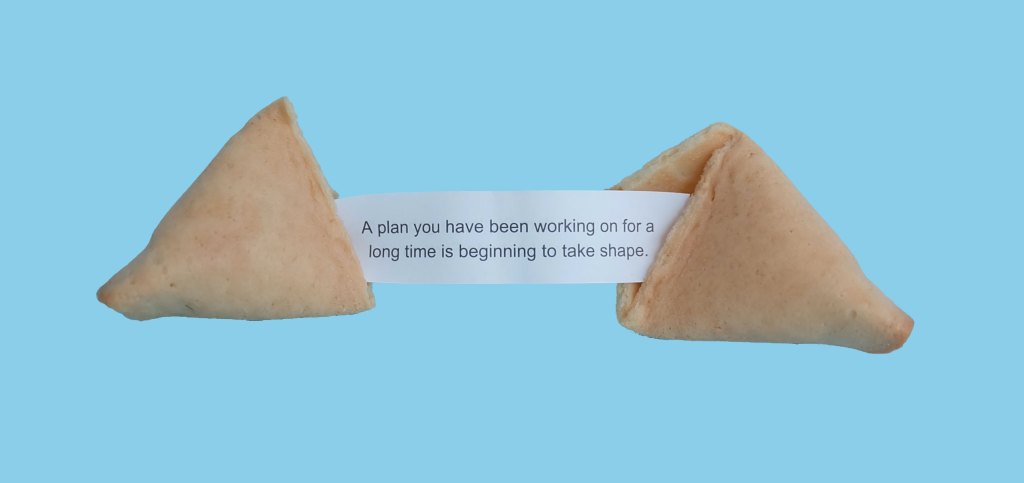
Futurism is a field that attempts to predict and simulate the future effects of current or future trends. The aim of futurism is to provide a better understanding of the future and to help individuals and organizations make more informed decisions.
One of the key benefits of futurism is that it allows us to anticipate and plan for potential changes in the world around us. By analyzing current trends and considering how they might evolve over time, futurists can help identify potential threats and opportunities. This can be particularly useful for businesses and organizations, as it allows them to make strategic decisions that will help them adapt to a rapidly changing world.
Another benefit of futurism is that it can help us understand the potential implications of our actions and decisions. By simulating the future effects of different scenarios, futurists can help us understand the potential consequences of our choices and guide us towards making better decisions. This can be particularly valuable for decision makers in government, business, and other fields, as it allows them to make more informed and effective choices.
In addition, futurism can also be used to spark creativity and innovation. By considering potential future developments, futurists can help stimulate new ideas and approaches. This can be particularly useful for businesses and organizations that are looking to stay ahead of the curve and innovate in their respective fields.Overall, futurism is a valuable field that can be used to simulate the future effects of current or future trends. By helping us anticipate and plan for change, understand the implications of our decisions, and stimulate creativity and innovation, futurism can be a powerful tool for individuals and organizations alike.
Given that change has become the norm instead of an exception in today’s world, I believe future thinking is a critical skill for individuals and a great capability for organizations. By taking mental trips (i.e., episodic future thinking) to a future that has not happened yet, individuals can achieve a peace of mind by thinking through how things that keep them awake at night may play through and prepare for them. Similarly, organizations can develop elaborate scenarios for alternative futures based on some mega or micro market and consumer trends of today.
The book that introduced me to the world of futurism is Imaginable by Jane McGonigal which I strongly recommend to everyone! I have been studying hard to further my knowledge and expertise in this amazing field and started delivering modules and professional workshops on future thinking which received overwhelmingly positive feedback also indicating how timely this topic is…
 Furkan A. Gur, PhD