I was sitting in a sauna recently when a familiar conversation unfolded. A couple of guys were trading notes on semi-famous people they follow on social media — podcast hosts, fitness gurus, productivity philosophers. The usual suspects. They compared supplements, fasting routines, sleep protocols, and cold exposure habits with the seriousness of a boardroom strategy meeting.
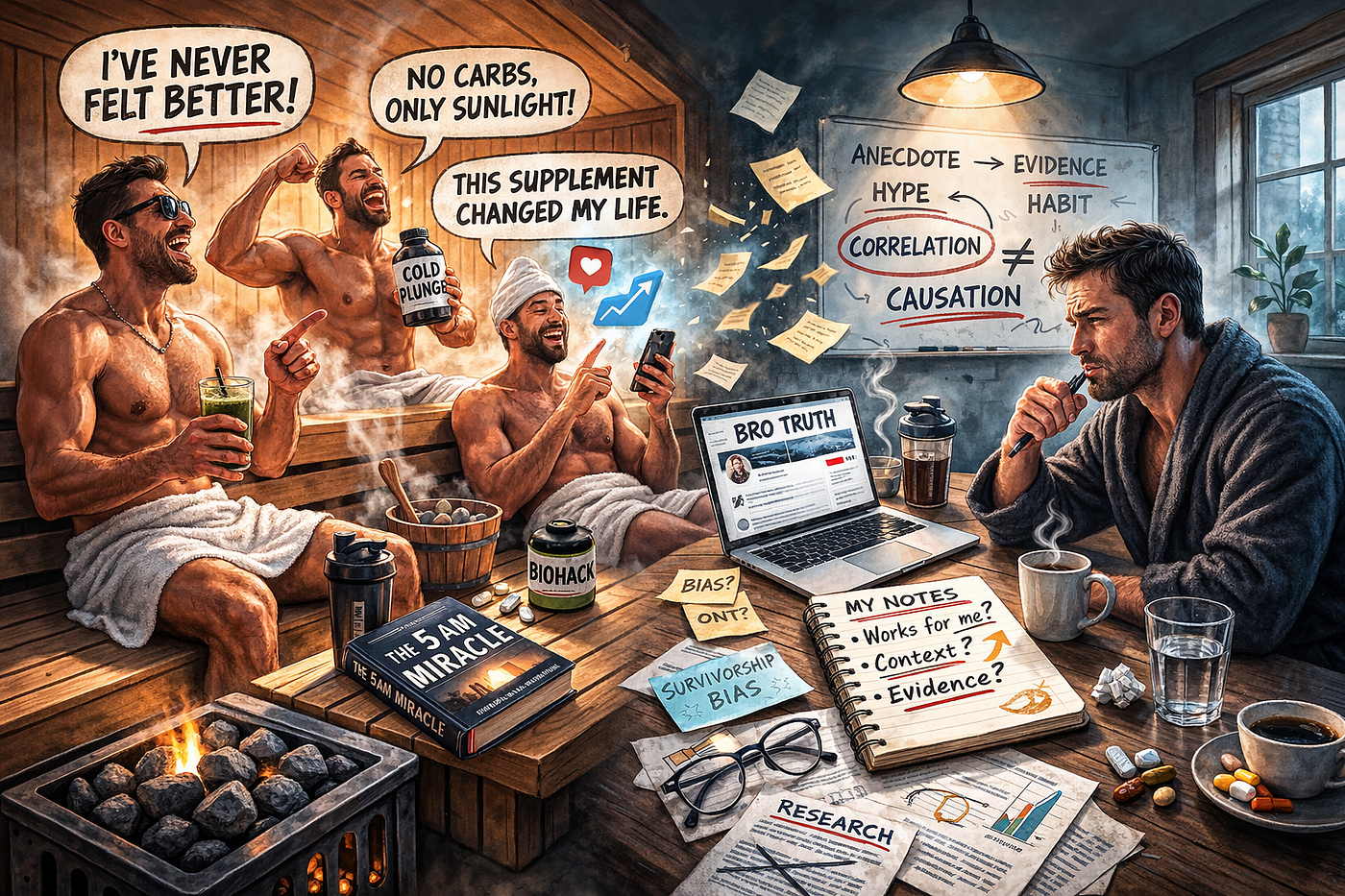
What struck me wasn’t just what they were discussing, but how they were discussing it. Each recommendation was delivered with absolute confidence. No caveats. No “this worked for him.” No acknowledgment that bodies, lives, and constraints differ. Just certainty. This, apparently, was truth.
Not too long ago, similar conversations sounded different. People would cite the news. Or a study. Or a survey. “I read somewhere that…” That approach had — and still has — plenty of issues. Research findings are averages. They flatten nuance. They often ignore context, incentives, and individual differences. But at least there was an implicit understanding that the source mattered, and that knowledge was provisional.
Today, we’ve replaced “according to a study” with “this guy I follow said.”
Let’s call it bro truth.
Bro truth is simple. It’s personal experience elevated to universal law. It’s one person’s routine, diet, or worldview presented as if it were a proven formula. What makes it especially dangerous isn’t that it’s wrong — sometimes it works — but that it’s shared without hesitation. Without humility. Without the slightest pause to consider that correlation is not causation, and that survivorship bias is doing a lot of heavy lifting.
The irony is that bro truth often feels more authentic than research. It’s a real person. A visible lifestyle. A compelling story. And stories are persuasive. We are wired to learn from them. But stories are also selective. We rarely hear about what didn’t work, what failed quietly, or what only worked because of hidden advantages — time, money, genetics, or sheer luck.
The problem isn’t learning from others. We should. The problem is mistaking inspiration for instruction.
There’s a big difference between “this helped me” and “this is what you should do.” Bros rarely make that distinction. And followers, eager for clarity in an overwhelming world, rarely demand it.
The practical takeaway here isn’t to dismiss influencers, podcasts, or anecdotal advice altogether. It’s to change how we consume them.
First, treat bro truth as a hypothesis, not a conclusion. Something to test cautiously, not adopt wholesale.
Second, ask what’s missing. What constraints does this person not have? What incentives do they have to share this advice? What failures might be conveniently absent from the narrative?
Third, reintroduce hesitation into our own conversations. Saying “this worked for me, but I’m not sure it’ll work for you” is not weakness. It’s intellectual honesty.
Ironically, the most trustworthy people are the ones who sound least certain. They acknowledge complexity. They leave room for doubt. They understand that human systems — bodies, businesses, families — are messy and context-dependent.
In a world flooded with confident bros and absolute claims, a little uncertainty might be the healthiest habit of all.
 Furkan A. Gur, PhD
Leave a comment